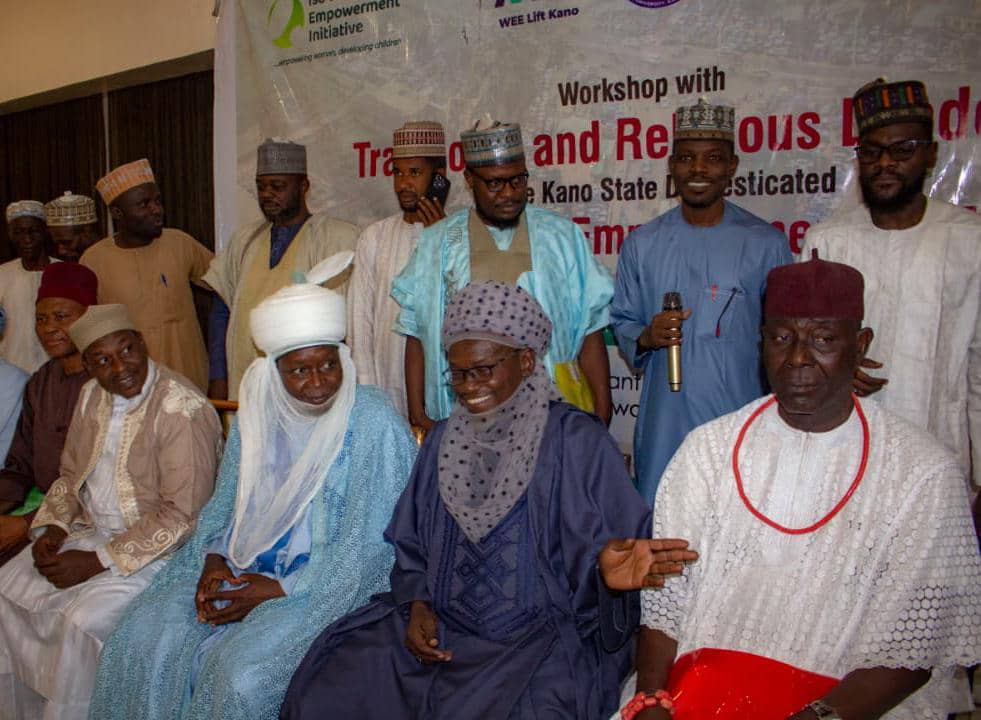
The WEE Catalyst Fund comprising of Isa Wali Empowerment Initiative (IWEI), and Fable Advisory, collaborated with the Centre for Islamic Civilization and Interfaith Dialogue (CICID), to host a strategic workshop aimed at raising awareness on the Kano State Women’s Economic Empowerment (WEE) Policy and promoting dialogue on religious and cultural support systems for women’s participation in the economy.
The event, held on Thursday, focused on deepening understanding of the newly domesticated WEE policy and identifying culturally grounded approaches that can strengthen women’s involvement in economic activities across the state.
Speaking at the event, the Executive Director of IWEI, Hajiya Amina Hanga, noted that empowering women economically has a direct positive impact on families, communities, and national development.
“Economically empowered women support their families, contribute to community development, and strengthen the nation as a whole,” she said. “Women make up almost half of the population, so investing in their empowerment is both logical and necessary.”
She explained that the WEE policy, recently domesticated by the Kano State Government, can only be effective if communities are fully aware of it and actively involved in its implementation.
“We are here to ensure awareness, encourage collaboration, and identify the roles each of us can play in making this policy work. Kano is known as the centre of commerce, and we want to continue building on that reputation,” Hanga added.
She appreciated CICID and other partners for their ongoing support through advocacy engagements with religious and traditional leaders. According to her, the policy is ready for launch, which will make it fully accessible as a public document.
The Director of CICID, Dr. Taufiq Abubakar Hussaini, described the domestication of the WEE policy in Kano State as a major step toward advancing women’s economic participation.
“Women’s economic empowerment reduces poverty, improves household welfare, and strengthens community development,” he stated.
Dr. Hussaini emphasized that religious and traditional leaders play a central role in shaping societal attitudes toward women’s participation in economic life.
“The purpose of this workshop is to deepen understanding of the WEE policy and to encourage supportive attitudes toward women’s contributions to the economy,” he said.
He outlined the objectives of the workshop as enhancing awareness, facilitating dialogue on religious and cultural perspectives, and promoting community acceptance-especially among men.
Also speaking, Professor Bala Ado Kofar Mata, the consultant who worked on the policy domestication process, said the policy aims to support women entrepreneurs by giving them access to the resources needed to expand their businesses and create jobs.
“The more women are supported to grow their enterprises, the more we improve the overall quality of life in Kano and Nigeria,” he explained.
He noted that Kano women are already known for their entrepreneurial spirit-engaging in traditional trading, food processing such as Gurasa production, and other small enterprises. The WEE policy, he said, will further strengthen these efforts.
The workshop brought together religious leaders from both Muslim and Christian communities in Kano, traditional leaders from different ethnic groups in Kano alongside entrepreneurs and representatives from Fable Advisory, Isa Wali Empowerment Initiative under the leadership of Hajiya Amina Hanga, and CICID led by Dr. Taufiq Abubakar Hussain.
Participants at the workshop agreed that traditional and religious leaders remain crucial in shaping community perceptions, encouraging acceptance, and ensuring the effective implementation of the WEE policy at the grassroots level.